



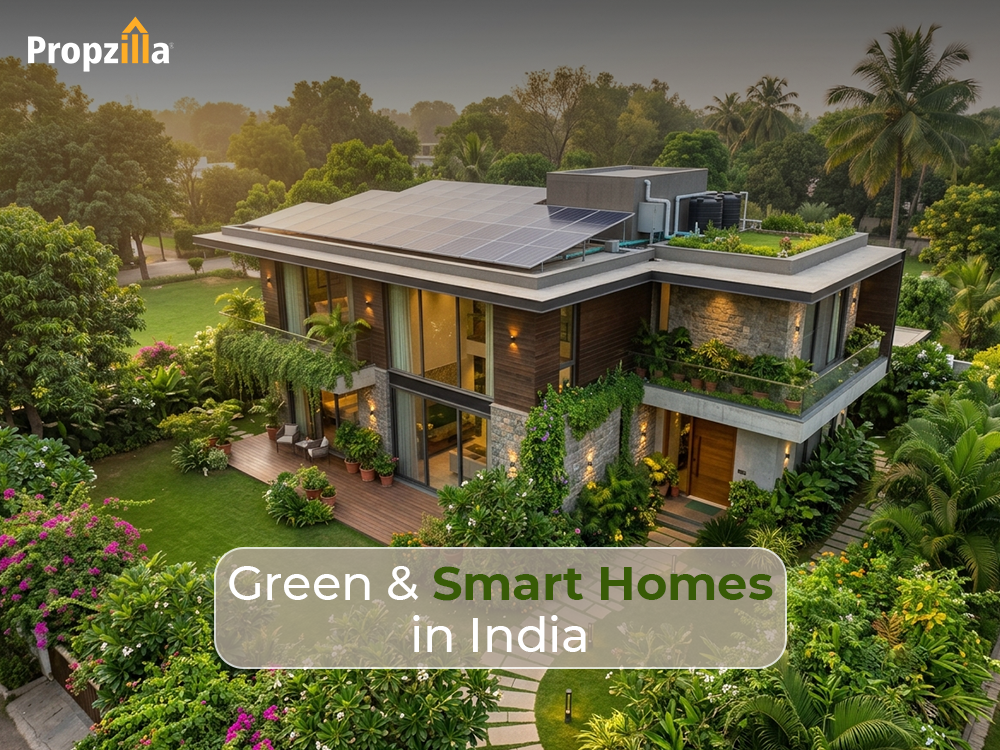
Buying a home has always been an important event in one’s life, and homebuyers today have far-reaching expectations of their homes. They do not just look for location and modern facilities, but they’re looking for the houses that are energy-efficient, environmentally sustainable, and smart technologically to enhance their lifestyle in the best possible way. These expectations of homebuyers have given birth to another trend of 'Green Smart Houses' in India, which combine both innovation and sustainability to build homes of tomorrow.
With the growth of urbanization and environmental issues, homeowners are increasingly becoming aware of their carbon footprint and energy costs. At the same time, house builders are coming up with new schemes for homeowners who are keen on building houses that conserve energy and ensure healthy living.
In the coming ten years, the demand for sustainable homes in India will grow because of the government initiatives, advances in technology, and increased awareness of consumers. Sustainable homes is an investment in the future of the homeowner and the environment. It is essential to learn about green smart homes prior to making investments.
The main objective of developing a Green Smart Home is to provide users with the optimum combination of technology and sustainability. While a green house is known for its eco-friendliness and sustainable approach towards development, a smart house makes use of automation and technological devices to make life convenient and safe for the inhabitants of the house. Thus, it can be said that the Green Smart House represents the ideal combination of sustainability and technology.
As opposed to normal houses, green smart homes are developed taking into consideration all aspects of sustainability right from the choice of construction materials and orientation of buildings to energy and water management within the house. Developers adopt environmentally friendly construction materials, natural ventilation systems, efficient insulation, and alternative sources of energy to minimize the environmental impact of the property.
These features together help the owners of green smart homes to save money, stay comfortable at home, and help in creating a better future for the planet.
The Indian real estate industry is experiencing a considerable change in the direction of sustainable development. Customers are better informed nowadays than ever before and realize that owning a house is not only about the present life but also about future obligations. Higher prices of electricity, shortages of water, pollution, and environmental issues have made people seek houses that have value not only in terms of comfort but also in terms of sustainability.
Perhaps one of the main factors that contribute to increasing demands for eco-friendly properties is economic benefits. Although green smart homes are somewhat more expensive at first purchase, they help customers save money on electricity and water bills because of the reduced consumption. The use of solar power, energy-saving household devices, and automation technology helps customers save money every month.
The government also played an important role in the above-mentioned process by introducing several programs and initiatives. Renewable energy and sustainable infrastructure programs have influenced developers positively and made them build houses according to greener standards. Green certifications of buildings like IGBC and GRIHA have gained popularity and trust among potential buyers.
The other important aspect is that of consumer attitude changes. The younger generation, including millennials, is becoming more conscious about healthy environments and homes of the future. They value such benefits as improved indoor air quality, availability of natural light, energy-efficient systems, and advanced technologies that make their lives easier. This trend has made developers develop homes that provide luxury and sustainability at the same time.
Given the growing trend among developers to apply green practices, buyers now have a greater choice of sustainable housing. If you’re also looking for your dream sustainable homes in India, explore the residential apartments by Propzilla which offers some of the best high-end residential projects in prime locations.
The green smart houses are unique because their design focuses on increasing efficiency and reducing negative environmental impact. The design of these houses is not dependent on conventional sources of energy and water but adopts modern techniques to establish a better balance.
Renewable energy is the most significant component. Residential complexes today equip themselves with rooftop solar panels to generate electricity for common spaces as well as individual houses, which reduces dependence on traditional power lines and cuts down the electricity bill for homeowners.
Water conservation is equally important. The rainwater harvesting systems capture the water falling from the sky for landscape and maintenance purposes, whereas the sophisticated sewage treatment facilities reuse the water for non-potable uses. Low-flow faucets and dual-flush toilets help in saving water.
Modern technology helps simplify our lives as all the regular chores become automated. Through their smartphones, residents of the house can operate lights, air conditioners, curtains, home appliances, and security systems. The motion sensors turn off the unnecessary lights, and the smart thermostats regulate the room temperature according to presence.
In addition, there is use of environmental construction materials that are better insulators and absorb less heat. Double glazing, fly ash bricks, recycled steel, low-VOC paints, and natural ventilation provide better health conditions indoors as well as a lesser need for cooling.
Some of the other sustainable features used in many new communities are:
Such new developments not only improve living standards but encourage sustainability as well.
Homeownership is a costly venture, and buying a sustainable property means that there are many gains associated with such an investment other than environmental concerns. The smart green homes offer savings, increased comfort, and better chances of resale, making them a desirable option for homeowners and investors alike.
The first benefit is decreased expenses. With efficient appliances, LEDs, better insulation, and renewable sources of energy, energy costs go down significantly, whereas water-saving technology helps decrease the cost of water supply each month. In this regard, savings soon justify the initial expense.
There are many factors that concern health, such as ventilation systems, daylight, clean air in the house, and non-toxic building material; all contribute to improved health conditions inside the house. Moreover, there is more space outside for sports activities in green communities.
In terms of investments, sustainable houses have become more appealing. Environmental consciousness has continued to rise, and people are now ready to spend extra money on houses with reduced maintenance expenses, innovative technologies, and environmentally friendly designs. In addition, it increases their resale and rental value, especially in big metropolitan cities.
Some of the important benefits of energy-efficient homes have
Green smart homes will remain one of the fastest-growing segments of the Indian housing market, as per the growing focus on sustainability in residential real estate.
The future of Green Smart Homes in India is very bright as sustainable development is slowly becoming a necessity and not an option. Rapid urbanization, climate change and increasing needs for resource-efficient residential homes are making developers think how their projects should be designed and constructed. Modern consumers do not get excited about luxury only anymore; they are interested in houses that are affordable to keep and technologically advanced.
In the nearest future, artificial intelligence (AI), the Internet of Things (IoT), and renewable energy sources are going to have an even greater role in residential projects. Future smart homes will be able to learn the habits of their residents and optimize the consumption of electricity accordingly. Lights will turn off in case of plenty of natural daylight, the work of air-conditioning system will be activated in case of necessity, and appliances will interact in order to avoid waste of electricity.
Sustainability is increasingly being used as a selling point for developers. Several top real estate firms in India have begun to design integrated townships, which comprise of sustainable landscapes, infrastructure, energy sources, and facilities into one complex. In essence, sustainability has stopped being a mere add-on for developers and has now become an integral part of their planning process.
Some trends are expected to influence the future as follows:
With the rise in affordability of these technologies, green smart houses are likely to become the norm of the future. From the perspective of potential homebuyers, this trend will make sure that buying green smart houses will prove to be cost-effective in the long run.
Real estate has always been perceived as a long-term investment, and sustainable housing has become one of the rapidly developing sectors within real estate. Nowadays, people take into account factors like efficient operation, environmental friendliness, and technological advancements when purchasing property.
Energy-efficient smart houses usually cost less in terms of maintenance and utilities than traditional houses. In the course of several years, energy bills and water bills can add up significantly, and the smart system will allow identifying maintenance problems in time and saving money on repairs.
The second benefit is high resale value. Taking into account the growing demand of sustainable development and green buildings, such houses will appraise higher than conventional ones. The target audience is mostly corporate professionals and NRIs.
Investors will find it attractive because sustainable residential projects attract better tenants, as they pay lower utility bills and live in a healthier environment with more secure smart technology systems.
There have been many changes in our definition of what constitutes a modern-day house. In addition to good designs and fancy features, people now want their houses to be energy efficient, environmentally friendly, and fitted with smart technology. This is exactly why Green Smart Homes in India are becoming increasingly popular among consumers.
Due to the use of renewable energy, water-saving technology, environmentally friendly building materials, and automation, such houses allow people to lead a comfortable life in an eco way. They allow reducing expenses for utilities every month, promoting a healthy environment indoors, and contributing to preserving nature at the same time.
Regardless of whether you are buying your first home or are simply looking to grow your real estate portfolio, the choice of a green smart home is one that will make sense both economically and environmentally. Under proper guidance, you can choose a home that works for you now and in the future.
Green Smart Homes in India are those homes that are constructed using sustainable methods and also include smart home technology. These homes are meant to cut down energy consumption and provide an energy-efficient, safe, and convenient lifestyle.
One of the reasons that have contributed to the growing popularity of green smart homes in India include environmental awareness, high costs of utilities, government initiatives towards sustainable construction, and a good living environment.
Some features of a green smart home include:
Though they are a bit expensive at first, the lower utility bills, lower water bills, and low maintenance costs will prove otherwise.
The use of automatic systems to control lighting, AC, and appliances will help save energy.
A greenhouse is based on sustainability and environmental conservation, whereas a smart house is based on automation and technology. The green smart house is a combination of both green and smart concepts.
IGBC (Indian Green Building Council) and GRIHA (Green Rating for Integrated Habitat Assessment) are India’s most reputed green building rating systems for buildings based on energy efficiency, water conservation, and sustainable architecture.
Some of the cities in India that have witnessed high demand for green smart houses are Bengaluru, Hyderabad, Pune, Mumbai, Chennai, Delhi-NCR, Ahmedabad, and Gurugram.

Oct 17, 2025

Sep 14, 2022

Sep 14, 2022

Dec 19, 2024

Apr 11, 2026
Jul 23, 2026

Sep 14, 2022

Apr 14, 2026
Sep 16, 2026
Aug 18, 2026

Jul 15, 2026








.webp)




.webp)

.webp)


.webp)
.webp)

0 Comments
Leave a Comment