




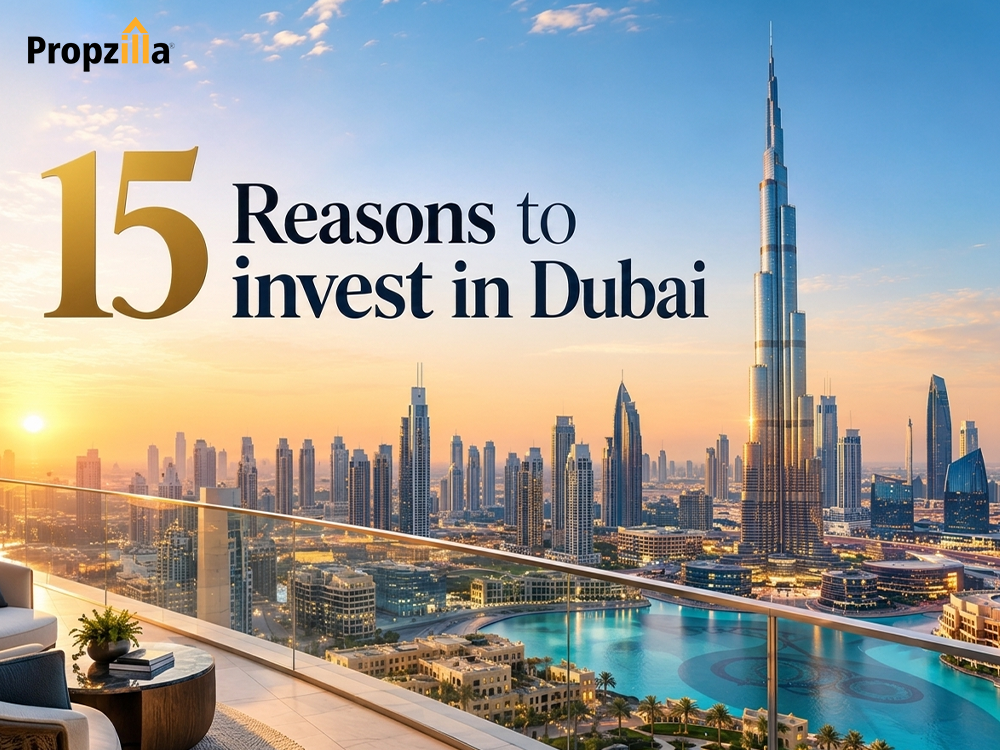
Dubai has definitely come a long way in terms of its property market. The investor is not limited to buying luxury apartments and waiting for the prices to increase. The investor today has a wide range of properties to choose from, including affordable apartments, family townhouses and branded residences.
For investors, the diversity of products is one of the main advantages of the Dubai real estate market. You can invest in real estate in Dubai for a rental income, capital gains, a second home, or residency.
However, just because you invest in Dubai doesn’t mean that your real estate will always be a sound investment. There are factors like location, developer, service fees, purchase price, rental demand, and exit strategy that you need to consider. With this in mind, here are 15 reasons for investing in Dubai real estate.
High rental demand is another major reason for choosing Dubai property investment. The city still draws professionals, families, entrepreneurs, and international firms, forming a vast pool of tenants. According to the Dubai Land Department, there were 1.38 million registered rental agreements in 2025 worth AED 126.4 billion. Dubai Land Department
It means that for an investor it will not matter whether the value of a property increases since the income from rent alone would be sufficient.
One of the main characteristics of Dubai is that there are relatively high rental yields on properties, although there are large differences between properties and locations.
Properties that are located in well-connected places where one can easily commute to work and enjoy lifestyle facilities can make good investments for rental. It is not the only factor to consider. Expenses like service charges, maintenance expenses, and financial expenses are also to be taken into account.
The UAE's tax structure is another reason international investors look at Dubai.
Dubai doesn't impose an annual property tax in the same way many major global property markets do. That can make the overall cost of holding an investment more attractive.
There are still transaction costs, registration fees, service charges and other expenses, so “tax-free” shouldn't be interpreted as "cost-free".
More people living and working in a city generally means more demand for homes.
The population of Dubai is continuously growing, and hence, its demand has spread beyond the conventional areas of prime locations. New settlements have become the choice for people seeking newer houses, spacious rooms, and better rent conditions.
For investors, following where residents are actually moving can be more useful than simply buying in the most famous neighbourhood.
Another reason why foreign investors consider investing in Dubai is its taxation system. Dubai does not levy annual property taxes similar to that of many global property markets. This can help reduce the total cost of the investment.
However, there are transaction costs, registration fees, service charges and other expenses that need to be paid, and "tax-free" does not mean “free of cost".
The tourism industry adds another dimension to property requirements. According to recent figures given by Engel & Völkers, 19.59 million international tourists stayed overnight in Dubai in 2025. Engel & Völkers
This creates a need for hotels, serviced apartments and holiday home rentals in proper locations. Short-term rentals do have their own licensing and management concerns; therefore, they should not be equated directly with traditional long-term rentals.
Dubai has created freehold zones where international investors can buy properties.This has made it easier for foreign investors to invest in Dubai properties without any previous connections to the United Arab Emirates. For international buyers, this is one big benefit in comparison with other markets that restrict foreign ownership.
For some investors, a property investment is much more than earning money. Investors in qualifying properties may be considered for UAE residency programmes. The current UAE Golden Visa programme includes a five-year residency programme for qualifying real estate investors at a minimum capital amount of AED 2 million, depending on the requirements.
Residence should not be the sole reason for buying a property, but for an investor who is thinking of investing in Dubai real estate, it could be an added advantage.
Dubai has made substantial investments in road networks, transport facilities, airport, utilities, and digital infrastructure.
From the perspective of investors in properties, infrastructure is functional in addition to being impressive. Properties that are easily accessible, close to workplaces or connected to existing amenities tend to be easier to let out and sell.
That's the reason infrastructure plans should be studied carefully before investing in a new locality.
Dubai is not a market where there is only one type of property. It means that investors can choose to invest in ready-to-use apartments, villas, townhouses, commercial property, and even off-plan projects. Structured payments from developers may be available for certain projects.
Different objectives mean different strategies. The investment strategy of an investor seeking quick returns may differ from that of other investors who are willing to wait until the off-plan building is completed.
The Dubai real estate market is regulated by the Dubai Land Department, along with other related regulatory mechanisms.
This is especially relevant for foreign investors, who do not know much about the purchasing process in Dubai. The registration, title, documentation, escrow for applicable projects, and regulated brokerages give you a better structure for carrying out the transaction. However, it doesn't mean that you shouldn't carry out your research.
The strategic location of Dubai, situated in-between Europe, Asia, and Africa, makes it a suitable destination for business and travelling.
The connectivity provided by Dubai International Airport, as well as the transport system in general, attracts people and companies from all over the globe. The international community is one of the factors that create the need for products and services that extend beyond the local market.
One of the greatest advantages of Dubai real estate is location diversity.
Downtown Dubai and Dubai Marina could be attractive to investors pursuing investment in the existing demand-driven market. Family-friendly communities could be a good fit for long-term tenants, and new locations could have different entry prices.
There is no such thing as the best area to invest in Dubai. Instead, the correct question is: what is the best area for a particular strategy and a budget?
There’s more to rental returns than just income. Properties in good locations may benefit from population growth, infrastructure development, scarcity of certain types of properties, and rising demand. The Dubai real estate market has seen substantial increases in prices already, so one shouldn’t expect that the rate will be maintained indefinitely.
It’s better to buy real estate based on figures that are realistic, not counting on an annual increase in prices.
Development of Dubai's cities continues with infrastructure, tourism, trade, and construction. Such development will not necessarily lead to an increase in the value of all properties. The one thing for sure is that this way allows people to see the big picture.
A good investment can only be made when one thinks outside the box: who will live in your building, why should he choose your building, what is the competition, how much will it cost you to maintain the property, and who will ultimately buy it from you?
It definitely can be for those investors who concentrate more on fundamentals than on publicity.
Market dynamics continue to remain quite impressive. The Dubai Land Department reported AED 252 billion in real estate transactions in Q1 2026, while foreign investment value reached AED 148.35 billion during the quarter. Dubai Land Department
But a strong market doesn't make every property a strong investment. The purchase price, location, developer reputation, rental demand, service charges, financing and resale prospects should all be assessed before committing capital.
Yes. Foreign investors have the opportunity to buy properties within freehold zones in Dubai, which has an already established market for overseas investors. However, the crucial factor is the choice of the right property and the associated purchasing and ownership costs.
The minimum investment that is needed when investing in Dubai property is different for every property due to the varying nature of property prices according to location, kind of property and its stage of development. It is also important to take into account the various expenses that will be incurred in the process.
Yes. According to the Golden Visa policy that exists in the UAE, foreign real estate investors may obtain a five-year residency visa upon investing in the country with a minimum capital of AED 2 million.
It depends on the purpose. The most popular areas may be lucrative in terms of rental income and liquidity, while the upcoming areas may be different. What matters is not just how popular an area is but also other things such as rental income and other factors.
Well, ready property would give you an opportunity for immediate income and more data on actual rental prices, while off-plan property could offer you terms of payment and new property, although you need to take into account factors like duration of construction, developers' reputation and competition from other projects in the future.
Besides the price of the property, you should consider the rental price, service charges, developer reputation, its location, future competition from other projects, cost of your investment and the audience in the resale market. It is advisable to consult a lawyer and real estate specialist when purchasing from abroad.

Oct 17, 2025

Sep 14, 2022
Sep 14, 2022

Dec 19, 2024

Apr 11, 2026

Jul 23, 2026

Sep 14, 2022

Apr 14, 2026

Sep 16, 2026

Aug 18, 2026

Sep 19, 2026

Jul 15, 2026











.webp)





.webp)


.webp)


.webp)
.webp)

0 Comments
Leave a Comment